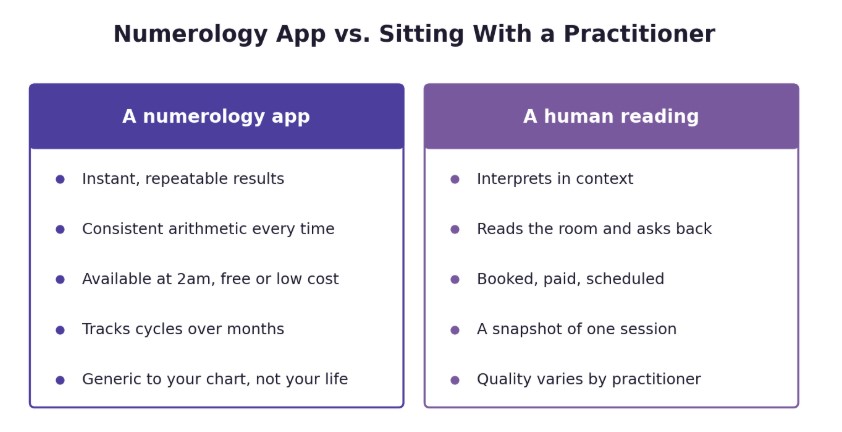

The usual framing is competitive: apps are replacing practitioners, or apps are a shallow substitute for real practice. Both versions miss what is actually happening, which is that the two formats are good at different things and most people who use numerology seriously end up using both.
Here is an honest comparison of what each does well, where each fails, and how to decide which one a given situation calls for.
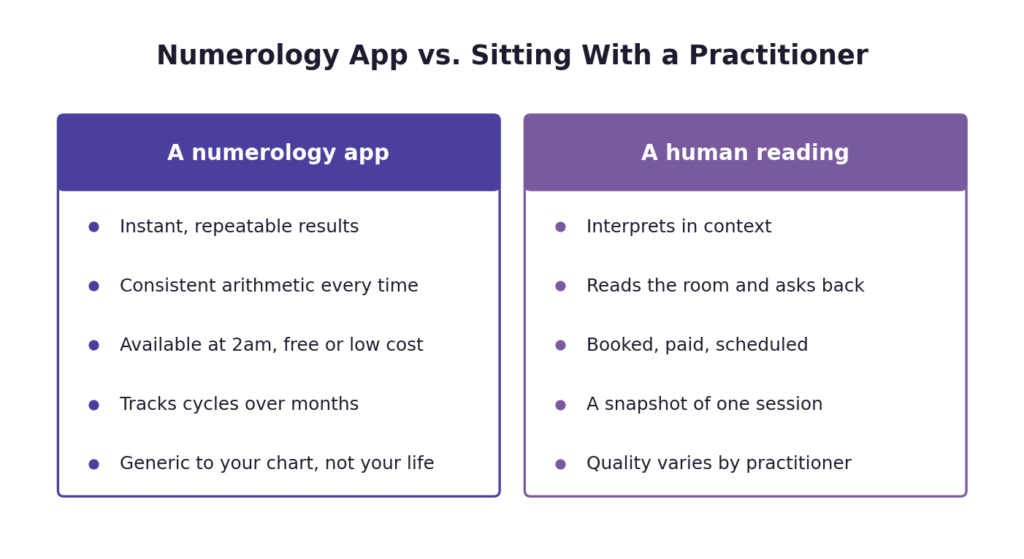
Image: Numerology app versus sitting with a practitioner
Where apps genuinely win
Arithmetic consistency. A well-built app runs the same calculation the same way every time. Human practitioners make arithmetic errors — not often, but the numbers involved in a full chart are numerous enough that mistakes happen. Software does not get tired at the end of a long day of charts.
Availability. Numerology’s most practical component is cycle work: Personal Year, Personal Month, Personal Day. Checking those against a human practitioner every month is neither affordable nor sensible. An app makes it a ten-second habit.
Cost. A full professional reading is a real expense. An app is free or a few dollars a month. For someone exploring whether the framework says anything useful at all, the app is obviously the correct starting point.
Privacy in the ordinary sense. Some people want to look at a difficult period in their life without narrating it to a stranger. An app requires no disclosure and no performance.
Longitudinal tracking. This is the underrated one. An app that logs your cycles builds a record, which means you can go back a year later and check whether the framework predicted anything. That is genuinely useful and almost impossible to do from occasional consultations.
Where a practitioner is not replaceable
Context. This is the whole thing. Your chart is the same whether you are twenty-two and choosing a degree or fifty-five and deciding whether to sell a business. The numbers do not change; what they mean for you does entirely. Software has no access to that. A practitioner asks what is actually going on and interprets accordingly.
The follow-up question. An app hands you a paragraph. A reading is a conversation, and the useful material usually surfaces in the third or fourth exchange, after the obvious interpretation has been offered and set aside. Nothing in an app format reproduces that.
Handling the ambiguous cases. Adoption, unknown birth times, name changes, uncertain records, competing traditions on the same question — these require judgement. An app either ignores the ambiguity or picks a default silently.
Delivery. A skilled practitioner reads how you are receiving something and adjusts. Software delivers the same paragraph to a person having an excellent year and a person in the middle of a crisis.
Where both formats fail in the same way
Neither format solves the fundamental limitation, which is that a system with nine outcomes is describing a very large number of people at once. Some generality is structural. The good version of both an app reading and a human reading is specific enough that you could disagree with parts of it; the bad version of either is flattering enough that disagreement never occurs to you.
Both are also vulnerable to the same failure of use: treating output as instruction. Numerology, read reasonably, is a vocabulary for describing situations and timing. It is not a decision engine, and neither format is improved by being asked to make choices on your behalf.
A sensible division of labour
The pattern that works for most people who use both looks roughly like this.
Use the app for the standing infrastructure — knowing your core numbers, tracking your Personal Year and Month, checking a date before you commit to it, building the record that lets you evaluate the framework over time. This is repetitive, calculation-heavy work that software does better than a person.
Book a reading for genuine crossroads. Career transitions, major relationship decisions, moments where you need someone to look at your specific circumstances rather than your abstract chart. Once a year, or when something significant is in play.
Read the app’s output before a session rather than instead of it. Arriving at a reading already knowing your numbers means the practitioner spends the time interpreting rather than calculating, which is what you are actually paying for.
Choosing an app that supports this
If the app is going to carry the infrastructure role, it needs to be more than a Life Path generator. The things that matter: it should state its calculation system, handle master numbers correctly rather than reducing 11 to 2, ask for your full birth name rather than a nickname, and cover cycles rather than only static numbers.
Regional practice varies more than people expect, and comparison guides written for a specific market — a roundup of USA numerology app options, for instance — tend to be more useful than global lists, since pricing models, tradition emphasis, and data handling all differ by region.
The transparency point is the one worth weighting most heavily. Platforms like Raka numerology that publish their methodology can be checked against a hand calculation in five minutes. Apps that treat the method as proprietary cannot be checked at all, which means you are evaluating the design rather than the substance.
The honest conclusion
The question is not which format is better. It is which one matches the job.
For repeatable calculation, cycle tracking, and cheap ongoing access, apps win comfortably and there is no serious argument otherwise. For interpretation of a real situation with real stakes, a competent human practitioner does something no current software does, because the missing ingredient is knowledge of your life rather than knowledge of numerology.
Most people who get value from the system use the app weekly and the practitioner occasionally. That is not a compromise between two rival formats. It is just using each for what it does.