
The modern university experience is often romanticized as a period of intellectual discovery and social growth. However, beneath the surface of campus life lies a more demanding reality. Undergraduate students regularly face a volatile mix of rigorous grading curves, compounding deadlines, and the pressure to maintain a competitive GPA. When high-stakes semesters arrive—packed with advanced seminars, research projects, and extracurricular commitments—the mental load can quickly become unsustainable.
Maintaining focus throughout these intense periods requires more than just raw willpower or endless caffeine. True academic endurance is rooted in cognitive science, stress management, and tactical workload distribution. When the sheer volume of essays, case studies, and exams begins to accumulate faster than you can process them, leveraging structured academic support systems and comprehensive assignment help platforms can provide the vital breathing room needed to regain control over your schedule. Understanding how your brain responds to prolonged stress allows you to transition from a state of constant crisis management to sustainable, high-level academic performance.
The Cognitive Cost of Academic Overload
To build long-term academic endurance, you must first understand the psychological and physiological mechanisms of burnout. Burnout is not simple exhaustion that can be cured by a long weekend of sleep; it is a state of chronic physical and emotional depletion resulting from prolonged, unresolved stress.
[Prolonged Cognitive Stress] ──> [Elevated Cortisol] ──> [Prefrontal Cortex Fatigue] ──> [Executive Dysfunction]
When you push your brain through weeks of continuous, high-intensity studying without adequate recovery, your body keeps your cortisol levels permanently elevated. This chemical imbalance actively impairs the prefrontal cortex—the region of the brain responsible for working memory, decision-making, and emotional regulation.
For an undergraduate student, this cognitive fatigue manifests in very specific ways:
- Reduced Retention: Reading the same textbook paragraph four times without processing its meaning.
- Procrastination Paralysis: Feeling so overwhelmed by the size of a task that starting it feels physically impossible.
- Diminishing Returns: Spending eight hours on an essay that normally takes three, producing lower-quality work in the process.
Recognizing these symptoms early is critical. Academic endurance is built on the principle of strategic pacing, ensuring that your cognitive resources are preserved for the tasks that demand the highest level of critical thinking.
Tactical Time Management: Moving Beyond the To-Do List
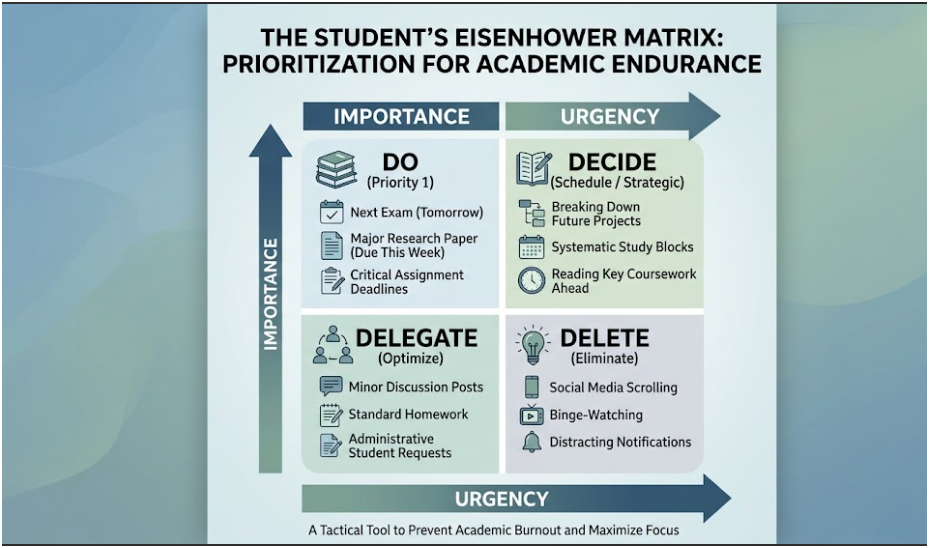
Most students approach a heavy semester by writing a massive, unstructured list of things to do. This approach often increases anxiety because the brain views every item—whether it is a minor discussion post or a major term paper—with the same level of urgency. To protect your mental energy, you must adopt systematic workflows used by corporate project managers and high-level researchers alike.
The Eisenhower Matrix for Students
Divide your weekly tasks into four distinct quadrants based on urgency and importance. Prioritize tasks that are both urgent and important (like an exam tomorrow), but dedicate consistent, daily blocks of time to tasks that are important but not urgent (like breaking down a major research paper due in three weeks). This prevents the chaotic, last-minute scrambles that spike cortisol levels.
Time-Blocking vs. Task-Switching
The human brain cannot multi-task efficiently. Every time you switch from writing an essay to checking a text message, or from studying calculus to checking an email, your brain incurs a “switching cost.” This drains your cognitive battery rapidly. Instead, practice time-blocking: dedicate immutable 90-minute windows to a single task, turn off all digital notifications, and take a mandatory 15-minute screen-free break between blocks.
Navigating the Complexities of STEM and Scientific Writing
While general essays and humanities papers present their own structural challenges, technical fields—collectively known as STEM (Science, Technology, Engineering, and Math)—demand a completely different cognitive skillset. Writing a comprehensive biology lab report, analyzing organic chemistry pathways, or programming an algorithmic data model requires intense quantitative precision and strict adherence to specific formatting styles, such as APA or IEEE.
The sheer volume of data analysis required in these courses is a leading driver of student burnout. When you are drowning in complex laboratory variables, statistical software outputs, and dense peer-reviewed literature, trying to manage it all alone can break your academic momentum. In these moments, tapping into specialized technical resources and targeted science assignment help from established academic providers by MyAssignment Services can prevent you from falling behind. Accessing precise guidance on complex methodologies allows you to master the core scientific concepts without getting hopelessly bogged down by mechanical data formatting.
Optimizing Your Academic Support Network
No successful academic works in complete isolation. Researchers, professors, and postgraduate scholars constantly collaborate and rely on peer-review networks to validate and refine their work. As an undergraduate student, you should view your education through a similar lens. Building an effective academic safety net is a sign of strategic planning, not a lack of ability.
Form structured study groups where members split up reading loads and teach core concepts to one another—the act of teaching a peer is one of the most effective ways to solidify information in your own long-term memory. Additionally, maximize the use of your university’s internal resources. Attend professor office hours with specific questions rather than vague confusion; this builds professional rapport and clarifies exactly what will be evaluated on high-stakes assessments.
When university writing centers are booked out or lack the specialized domain expertise your coursework demands, external professional consulting networks fill the structural gaps, ensuring your work meets rigorous institutional standards.
The Physical Foundations of Mental Focus
It is impossible to separate cognitive endurance from physical well-being. Your brain is a metabolic organ that consumes roughly 20% of your body’s energy. If you neglect its fundamental physical requirements, your academic performance will inevitably decay, regardless of how many hours you sit at your desk.
| Physical Pillar | Impact on Cognitive Function | Practical Student Strategy |
| Sleep Architecture | Heavy REM sleep consolidates memories and clears metabolic waste from brain cells. | Maintain a consistent wake time, even on weekends, to stabilize your circadian rhythm. |
| Nutritional Stabilitiy | Glucose spikes from refined sugars cause dramatic energy crashes and brain fog. | Fuel long study sessions with complex carbohydrates, healthy fats, and proteins for sustained focus. |
| Active Recovery | Cardiovascular exercise increases BDNF, a protein that supports neuroplasticity and learning. | Take a 20-minute brisk walk outside between heavy study blocks to reset your attention span. |
Strategic Delegation: The Secret Weapon of High Achievers
One of the hardest lessons for an ambitious student to learn is that you cannot give 100% of your energy to 100% of things simultaneously. True prioritization often requires strategic delegation. High-achieving individuals across all professional industries understand how to outsource secondary or highly repetitive tasks so they can focus their limited time on their primary areas of impact.
In a university setting, this means identifying which assignments carry the highest weight toward your final grade or future career prospects. If you have a massive final exam worth 50% of your grade in your major, it is counterproductive to spend 15 hours formatting an introductory-level elective paper. By utilizing external academic resources to streamline your secondary writing assignments, you protect the valuable hours needed to master your core competencies, ultimately leading to a more balanced and successful semester.
Frequently Asked Questions
Q.1 How can I tell the difference between normal semester fatigue and actual academic burnout?
Ans: Normal fatigue is remedied by a night of deep sleep or a day off. Burnout, however, leaves you feeling emotionally detached, cynical about your classes, and physically exhausted even after resting. If your grades are dropping alongside your motivation, you are likely experiencing burnout.
Q.2 Does utilizing online academic assistance violate the principles of academic integrity?
Ans: Not when used correctly as an educational tool. Professional academic support services provide model papers, structural outlines, and expert data analysis that serve as high-quality study guides. Reviewing these materials helps you understand complex topics, correct your formatting errors, and write your own original arguments more efficiently.
Q.3 How can I manage my time effectively if I have to balance university with a part-time job?
Ans: When balancing work and study, traditional scheduling often fails. You must rely heavily on micro-productivity. Break your major assignments down into 15-minute tasks (e.g., writing a single paragraph or reading two pages). Utilize mobile tools to review notes during commutes or down periods at work to keep your momentum without needing massive blocks of free time.
Q.4 How can I recover my GPA if a difficult semester has already caused my grades to drop?
Ans: GPA recovery requires a systematic approach rather than panicking. First, analyze your transcripts to identify whether your lower grades were caused by specific subject difficulties (like advanced math) or general workload management issues.
Q.5 What is the most effective way to read dense scientific or academic journal articles without losing focus?
Ans: Do not read academic papers chronologically from page one to the end. Instead, utilize the “Three-Pass Method.” First, read the Title, Abstract, and Conclusion to understand the core finding and determine if the paper is actually relevant to your research. Second, scan the section headings, charts, and data visualizations to understand the methodology.
About The Author
I’m Min Seow, an academic research consultant and content strategist working alongside MyAssignment Services. With a background focused on helping undergraduate students navigate complex academic writing and research workflows, I specialize in breaking down advanced study methodologies into actionable, stress-free strategies.