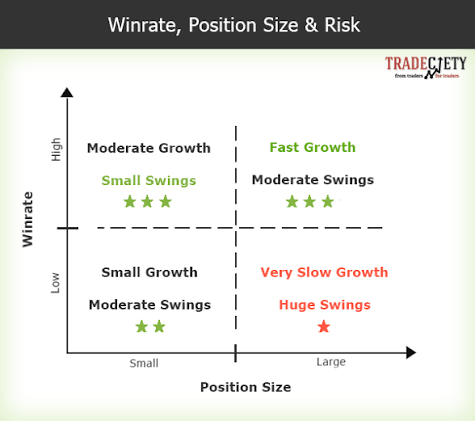

Many new traders stay up all night hunting for perfect chart signals, thinking entries are the secret to market success. The harsh reality is that a brilliant strategy will still blow up your account if your position sizes are chosen at random. Learning to align your lot sizes mathematically with a strict defensive model is what separates professional execution from blind gambling.
What exactly is a 1% risk model, and why should a beginner care?
The 1% risk model is a strict capital preservation rule where you promise never to lose more than one percent of your account balance on any single trade. If you have a $5,000 account, your maximum financial loss on a bad setup is capped exactly at $50.
Think of your trading capital like fuel in a plane’s gas tank. If you risk 10% per trade, a normal string of consecutive losses drains your tank instantly, grounding you permanently before you even learn the ropes. Risking just 1% gives you a massive runway of one hundred attempts to navigate errors and master market dynamics. It shifts your focus completely away from emotional panic, letting you trade with a calm, analytical mindset because no individual loss can seriously damage your future.
Does risking 1% mean I can only trade with 1% of my account balance?
This is the single biggest point of confusion for people stepping into the markets. Risking 1% does not mean your total position size is limited to $50; it means the distance between your entry price and your protective stop-loss equals $50.
Think of leverage like a temporary financial boost provided by your broker to amplify your market exposure. By utilizing tools from a reliable best cfd broker, you can put down a tiny deposit to control a much larger trade value. If your technical stop-loss gets triggered, the platform cuts the trade instantly, ensuring only your pre-calculated $50 risk vanishes. Leverage determines the size of the position you can control, while your stop-loss distance ensures your real-world loss never breaches your strict 1% boundary.
How do I figure out my actual position size for a trade?
Calculating your exact lot size requires a simple three-step formula that strips all the guesswork out of your execution. First, multiply your account balance by 1% to find your total dollar risk. Second, look at your technical chart and measure the exact distance in pips between your desired entry point and your structural invalidation level.
Finally, divide your dollar risk by your stop-loss distance multiplied by the pair’s pip value. Suppose you want to trade EUR/USD with a 20-pip stop-loss on a $10,000 account, making your maximum risk $100. Because a standard micro lot pays out roughly $0.10 per pip, your math dictates an exact position size of 0.50 lots. Doing this before clicking a button ensures complete transparency across your entire portfolio.
Why can’t I just use the exact same lot size on every single trade?
Forcing a static lot size onto every trade setup is a dangerous structural trap. Market volatility changes constantly, meaning a safe stop-loss on a quiet currency pair might be 15 pips, while a volatile pair requires 60 pips to breathe.
If you use a fixed 0.50 lot size on both setups, you are risking radically different dollar amounts without realizing it. A 60-pip stop-loss with a fixed lot size multiplies your financial exposure by four, completely breaking your defensive model. Your lot sizes must act like an accordion, automatically expanding when your stop-loss is tight and shrinking when the market demands a wider buffer zone. This mathematical flexibility is an absolute core pillar of proper forex trading for beginners who want to build stable equity curves.
What should I do if my account is too small to fit the 1% math?
When you are managing a small starting balance, like $500, a 1% risk limit gives you a tiny $5 budget per trade. If your strategy requires a wider 30-pip stop-loss, a standard mini lot will exceed your risk parameters instantly.
To solve this friction, you must utilize micro lots or nano lots, which allow you to trade smaller contract units. A micro lot reduces the financial impact of a single pip movement down to just ten cents. If your broker’s smallest available position size still forces you to risk more than your 1% model allows, you must step back and refine your setups on a demo account. Never compromise your risk parameters simply because you are eager to trade; preserving your process is always more valuable than chasing small retail gains.
How does this position sizing rule protect my psychology during a losing streak?
Losing streaks are an inevitable reality of professional trading that every market participant faces eventually. When you risk random, oversized amounts, a string of three bad trades can easily wipe out a third of your account, triggering an emotional spiral of revenge trading.
When your position sizing is locked into a tight 1% framework, a four-trade losing streak only costs you a minor 4% of your total capital. Your account equity barely feels the dent, which completely removes the psychological urge to override your strategy. You can accept the loss as a standard cost of doing business and focus purely on executing your next setup cleanly. True confidence doesn’t come from guessing right every time; it comes from knowing your capital structure is completely bulletproof against bad luck.
Practical Takeaway
Before executing your next position, pull up an online lot size calculator and input your exact account balance alongside your technical stop-loss distance. Round your final calculation down to the nearest micro lot to ensure you never accidentally over-expose your equity. By making this quick calculation a non-negotiable step in your pre-trade routine, you take complete control of your downside and give your strategy the structural safety it needs to succeed over the long haul.
For a deeper dive into adjusting your trade size dynamically to match changing market conditions, this Tutorial on Position Sizing and Capital Preservation provides a concrete step-by-step breakdown of how institutional participants protect their accounts from major drawdowns.